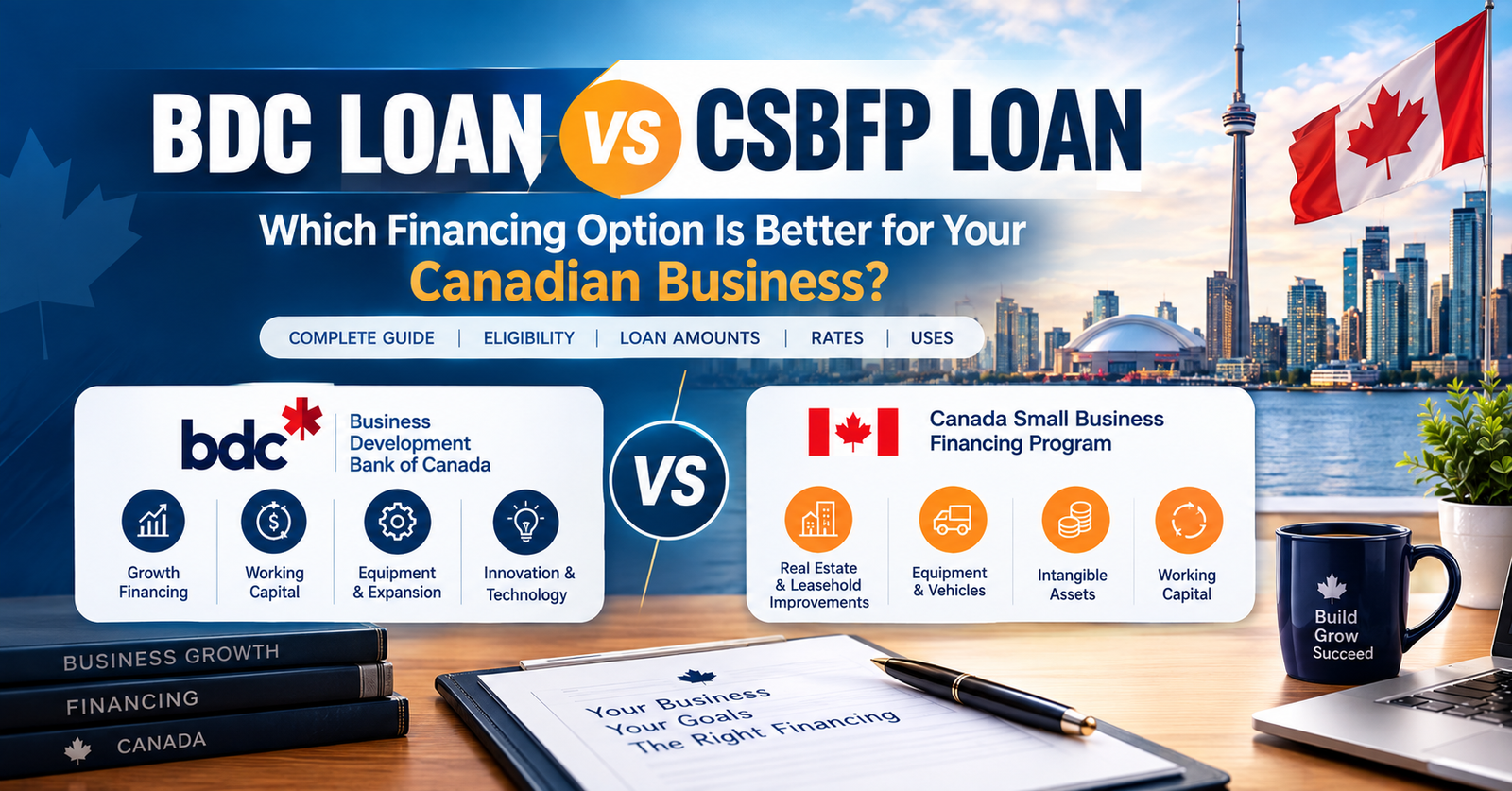
BDC Loan vs CSBFP Loan: Which Financing Option Is Better for Your Canadian Business? (2026 Guide)
When Canadian business owners need financing, two options frequently come up: BDC financing and the Canada Small Business Financing Program (CSBFP).
Both can help businesses access capital, but they work differently.
The Business Development Bank of Canada (BDC) provides financing directly through its own lending programs, while the CSBFP is a government program that helps participating financial institutions share lending risk with eligible small businesses.
For entrepreneurs searching for a BDC loan vs CSBFP loan, the most important question isn’t simply which program offers more money. It’s which financing structure best matches your business, the purpose of the funds, your financial profile and the type of lender relationship you want.
BDC Loan vs CSBFP Loan: Quick Comparison
Feature | BDC Financing | CSBFP Financing |
Provider | BDC | Participating financial institution |
Government-backed | BDC is a federal Crown corporation; its loans are BDC financing | Government shares risk with participating lenders |
Typical purpose | Growth, working capital, equipment, expansion and other projects | Eligible real property, equipment, leasehold improvements, intangible assets and working capital |
Maximum | Depends on product; BDC Small Business Loan currently up to $350,000 | Up to $1.15 million per borrower, subject to program limits |
Working capital | Available through appropriate BDC products | Available under eligible CSBFP provisions |
Approval | BDC assesses the business and owners | Financial institution makes the lending decision |
Best suited for | Businesses seeking flexible growth financing | Eligible small businesses seeking financing through participating institutions |
The CSBFP currently permits up to $1 million in term loans plus up to $150,000 in lines of credit, for a maximum of $1.15 million per borrower, subject to the program’s rules.
What Is a BDC Loan?
BDC is Canada’s development bank for entrepreneurs.
It offers a range of financing products for Canadian businesses, including:
- Small business loans
- Working capital loans
- Equipment financing
- Commercial real estate financing
- Business purchase financing
- Startup financing
- Technology financing
BDC’s current Small Business Loan offers financing of up to $350,000, with different requirements and terms depending on the amount requested.
BDC also considers factors beyond a simple credit-score calculation, including business potential, cash flow, management and the purpose of the financing.
What Is the CSBFP?
The Canada Small Business Financing Program, commonly abbreviated as CSBFP, helps eligible Canadian small businesses access financing through financial institutions.
The government shares the risk of eligible loans with participating lenders, making it easier for some small businesses to obtain financing.
You may still hear people call this the CSBFL loan or Canada Small Business Loan. The official program name is Canada Small Business Financing Program (CSBFP).
Who Is Eligible for CSBFP Financing?
Most Canadian startups and existing businesses with gross annual revenues of $10 million or less may be eligible, subject to the program’s requirements.
Eligible structures can include:
- Corporations
- Sole proprietorships
- Partnerships
- Cooperatives
Farming businesses are generally excluded from CSBFP and have a separate federal financing program.
Eligibility does not mean automatic approval. You still need to satisfy the participating financial institution’s lending requirements.
What Can a CSBFP Loan Be Used For?
One of the major advantages of the CSBFP is the range of eligible uses.
Depending on the financing structure, funds can be used for:
- Commercial real estate
- Leasehold improvements
- Equipment
- Commercial vehicles
- Certain intangible assets
- Eligible working capital
CSBFP lines of credit can be used for eligible working-capital costs and day-to-day business operating expenses.
What Can You Use a BDC Loan For?
BDC offers financing for a broader range of business objectives through different products.
For example, its Small Business Loan can be used for:
- Inventory
- Marketing campaigns
- Paying suppliers
- Hiring or training employees
- Developing products
- Expansion
- Entering new markets
BDC also offers specialized financing for equipment, commercial real estate, technology, acquisitions and working capital.
BDC Loan Requirements
Requirements depend on the specific BDC financing product.
For its current Small Business Loan, businesses are more likely to qualify when they:
- Operate in Canada
- Have been generating revenue for more than 24 months
- Are currently profitable
- Have a good credit track record
For loans under $100,000, BDC currently lists annual revenue of at least $100,000 and a personal credit score of 600 or higher among its indicative eligibility criteria.
For financing between $100,000 and $350,000, BDC currently lists annual revenue of at least $250,000, a personal credit score of 600 or higher and financial statements for the previous 24 months. Meeting these criteria does not guarantee approval.
CSBFP Loan Requirements
CSBFP eligibility starts with the program requirements, but the actual financing is provided by a participating financial institution.
The lender will evaluate your:
- Business plan
- Financial statements
- Revenue
- Cash flow
- Credit history
- Ability to repay
- Proposed use of funds
The CSBFP itself does not mean that every eligible business automatically receives financing.
The financial institution must still approve the proposal.
BDC vs CSBFP: Which Offers More Money?
This is one area where the CSBFP currently has a higher program maximum.
BDC Small Business Loan
Up to $350,000 under the current Small Business Loan product.
CSBFP
Up to $1.15 million per borrower, consisting of up to:
- $1 million in term loans
- $150,000 in lines of credit
subject to program-specific limits on eligible purposes.
However, a higher maximum does not mean you should borrow more.
The appropriate financing amount should be based on your actual business requirement and repayment capacity.
BDC Loan vs CSBFP Interest Rates
Interest rates are not simply a matter of choosing “BDC” or “CSBFP.”
BDC
BDC states that its Small Business Loan interest rate is based on its current floating base rate plus a variance determined using the applicant’s personal and business information.
Therefore, your rate can vary depending on your circumstances.
CSBFP
The CSBFP has maximum allowable interest rates.
For term loans, the current program allows:
- Variable: lender’s prime rate + up to 3%
- Fixed: lender’s single-family residential mortgage rate + up to 3%
For CSBFP lines of credit, the maximum is currently prime + 5%.
Always confirm the actual rate, fees and repayment terms with the lender before accepting financing.
CSBFP Registration Fee
CSBFP financing also has a 2% registration fee, which can be financed as part of the loan under the program rules.
This is an important cost to include when comparing financing options.
Don’t compare only the headline interest rate.
Consider:
Interest + registration fees + lender fees + other financing costs = total cost of borrowing
Which Is Better for Working Capital?
This depends on your specific situation.
BDC may be attractive when:
- You need working capital for growth.
- You want financing tailored to your business.
- You have an established and profitable business.
- You need a longer-term financing structure.
BDC specifically offers working-capital financing designed to help businesses protect cash flow and invest in growth.
CSBFP may be attractive when:
- Your business meets the program eligibility criteria.
- Your financing purpose fits eligible CSBFP categories.
- You want to work through a participating financial institution.
- You need a larger eligible financing facility.
Which Is Better for Buying Equipment?
Both can potentially be useful.
CSBFP specifically permits eligible financing for the purchase or improvement of new or used equipment, including commercial vehicles.
BDC also offers dedicated equipment financing.
Therefore, compare:
- Financing amount
- Interest rate
- Term
- Down payment
- Security requirements
- Fees
- Monthly payment
rather than choosing based solely on the program name.
Which Is Better for Buying Commercial Property?
CSBFP can finance eligible commercial real property under its program rules.
BDC also offers commercial real estate financing for businesses purchasing land or buildings and for certain construction or renovation costs.
For a major commercial property transaction, the financing structure can be significantly more important than simply choosing the program with the lowest advertised rate.
What About Startups?
Startups should pay particular attention to eligibility.
BDC has specific startup financing, with its current program generally requiring the business to be based in Canada, have at least 12 months of operation, generate revenue and have a good credit track record.
CSBFP, meanwhile, explicitly includes many startups among potentially eligible businesses, provided they meet the program requirements.
For a new business, the strength of the business plan, owner’s experience, projected cash flow and financing purpose can be particularly important.
Can You Get Both BDC and CSBFP Financing?
Potentially, but you should not assume that you can simply stack unlimited financing from different programs.
Each financing arrangement has its own eligibility, debt-servicing and lender requirements.
If your business needs multiple financing facilities, the lenders may consider your total debt obligations and overall ability to repay.
A financing professional can help structure multiple facilities appropriately.
BDC Loan vs CSBFP Loan: Which Should You Choose?
Choose BDC Financing When:
You need growth-oriented financing
BDC has multiple financing products designed around business growth, working capital, equipment, technology, acquisitions and other projects.
You have an established business
Some BDC products have specific revenue, profitability and operating-history requirements.
You want flexible financing
Certain BDC products offer interest-only periods and longer amortization options.
Consider CSBFP When:
Your business is a qualifying Canadian small business
Businesses with gross annual revenue of $10 million or less can potentially qualify, subject to the program and lender requirements.
Your financing purpose fits the program
CSBFP can support eligible real property, equipment, leasehold improvements, intangible assets and working capital.
You need a larger eligible financing facility
The program currently permits up to $1.15 million per borrower across its term-loan and line-of-credit limits.
What Documents Should You Prepare?
Regardless of which financing route you pursue, prepare a professional financing package.
Business Documents
- Articles of incorporation
- Business registration
- Ownership information
- Business plan
- Description of financing requirements
Financial Documents
- Financial statements
- Business bank statements
- Corporate tax returns
- Accounts receivable
- Accounts payable
- Existing debt schedule
Personal Documents
- Government-issued identification
- Personal financial information where required
- Personal credit information
Project Documents
Depending on the loan:
- Equipment quotations
- Purchase agreements
- Property information
- Renovation estimates
- Business acquisition documents
- Marketing or expansion plans
How to Improve Your Chances of Approval
Before applying, make sure your application answers four basic questions:
- Why do you need the money?
Be specific.
Instead of:
“I need money to grow.”
Explain:
“We are seeking $150,000 to purchase equipment that will increase production capacity by approximately X units per month.”
- How will the money generate a return?
Explain how the financing will contribute to:
- Revenue
- Profitability
- Efficiency
- Capacity
- Customer acquisition
- How will you repay it?
Prepare a realistic cash-flow forecast showing how debt payments will fit into your business.
- Why is your business capable of executing the plan?
Demonstrate:
- Management experience
- Industry knowledge
- Existing customers
- Revenue history
- Financial performance
BDC vs CSBFP: The Bottom Line
There isn’t one universally better option.
BDC financing can be attractive for established businesses seeking flexible growth, working capital, equipment, technology or expansion financing.
CSBFP financing can be particularly useful for eligible Canadian small businesses seeking financing through a participating financial institution for approved purposes.
The best financing depends on:
- Amount required
- Purpose of financing
- Business age
- Revenue
- Profitability
- Credit profile
- Cash flow
- Security available
- Repayment capacity
Instead of asking “Which loan is better?”, ask:
“Which financing structure is the best fit for my business and the specific project I’m financing?”
That approach can help you avoid taking on the wrong type of debt.
FAQ
People sometimes use “CSBFL” or “Canada Small Business Loan” informally, but the official current program name is Canada Small Business Financing Program (CSBFP).
BDC is Canada’s development bank for entrepreneurs and operates separately from traditional commercial banks. It provides financing and advisory support to Canadian businesses.
Neither is automatically easier. Both involve eligibility requirements and assessment of the business and its ability to repay.
Many Canadian startups can potentially qualify if they meet the program’s requirements. The participating lender makes the financing decision.
Yes. BDC offers financing specifically designed for working capital, and its Small Business Loan can also support various business expenses and growth initiatives.
CSBFP has specific security rules, and the participating financial institution will determine the applicable security based on the program and financing. It should not be assumed to be an unsecured loan.
In negotiations, I’ll represent you. When it comes to discussing mortgages with their bank, many customers are unsure or uneasy. Even if you have an existing relationship with your branch, I can use that relationship to your advantage when negotiating your mortgage, ensuring that you get the best rates and terms possible. Call me right now for a free, no obligation consultation. Call +1 (431) 999-8485 or Apply now!