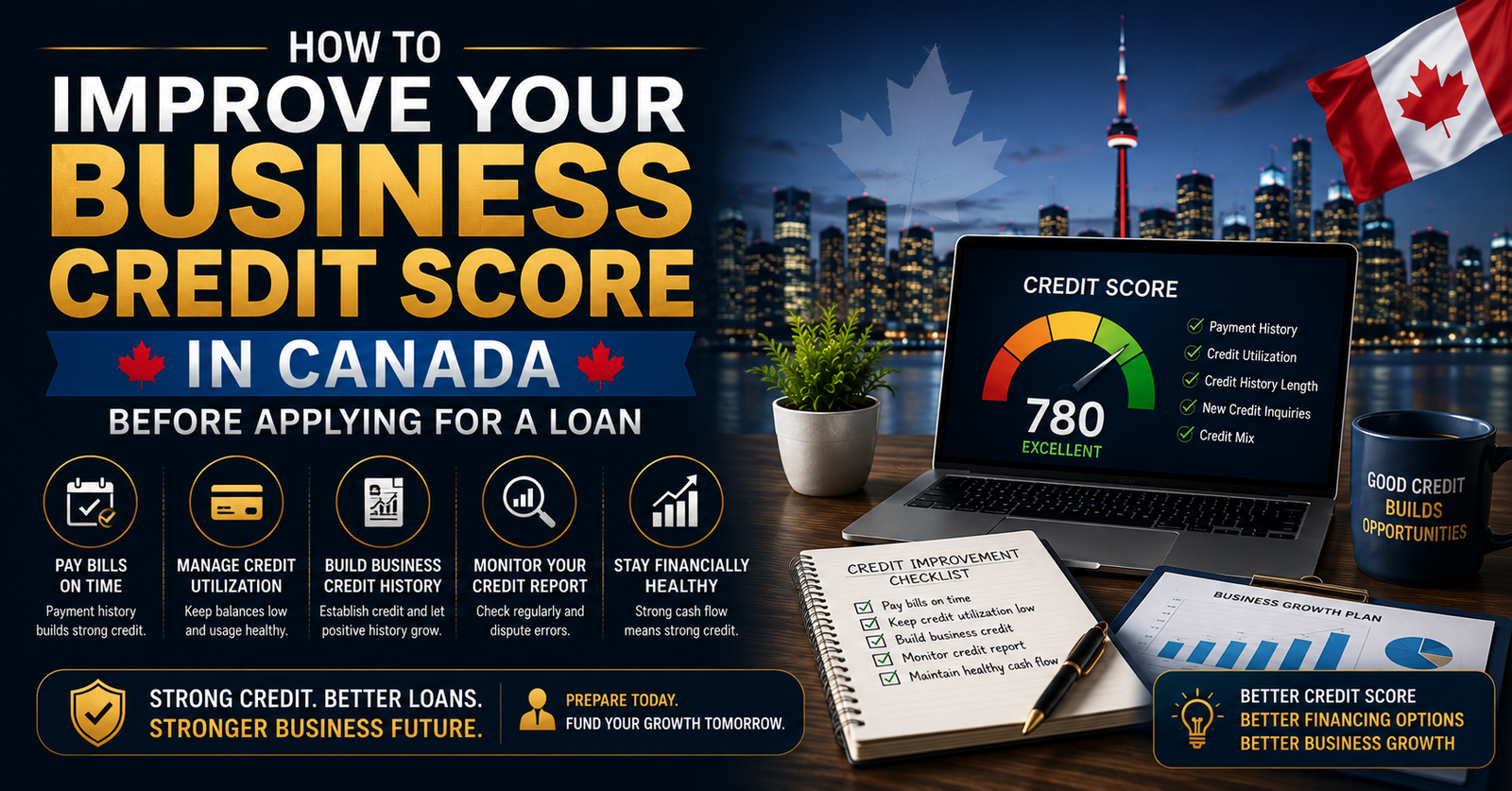
How to Improve Your Business Credit Score in Canada Before Applying for a Loan
For Canadian entrepreneurs, a strong business credit profile can make it easier to access financing, negotiate better borrowing terms and build stronger relationships with lenders.
Whether you’re applying for a business loan, business line of credit, working capital loan, BDC financing or other forms of business funding, your credit profile can play an important role in the lender’s assessment.
However, business owners often focus only on their personal credit score and overlook their company’s commercial credit history.
In this guide, we’ll explain how business credit works in Canada, what lenders look at, common mistakes that can hurt your profile, and practical steps you can take to improve your business credit before applying for financing.
What Is a Business Credit Score?
A business credit score is a measure of a company’s creditworthiness.
It helps lenders and other businesses assess the likelihood that a company will meet its financial obligations.
Commercial credit scoring is different from personal credit scoring. BDC notes that commercial scores can use factors such as payment history, length of credit history, industry and credit inquiries. Different commercial scoring models can also use different ranges and methodologies.
A lender may use your business credit profile to evaluate whether your company represents an acceptable level of risk.
Why Does Business Credit Matter?
A strong business credit profile can help when you’re applying for:
- Business loans
- Business lines of credit
- Equipment financing
- Supplier credit
- Commercial leases
- Business credit cards
- Working capital financing
Credit is an important part of business financing because lenders want evidence that a company has historically managed its financial obligations responsibly.
A stronger credit profile may also improve your negotiating position when discussing financing terms.
Business Credit vs Personal Credit
This distinction is especially important for small business owners.
Personal Credit
Your personal credit profile reflects your individual borrowing history.
It can include:
- Personal credit cards
- Personal loans
- Mortgages
- Lines of credit
- Payment history
Business Credit
Business credit reflects the financial behaviour of your company.
It can include information related to:
- Business credit facilities
- Supplier accounts
- Payment performance
- Collections
- Liens
- Insolvency information
- Business-related credit inquiries
TransUnion’s Canadian business credit reports can include business profile information, trade data, insolvency information, legal items, liens and collections, and supplier trade repayment performance.
Do Canadian Lenders Look at Personal Credit for Business Loans?
Often, yes.
For small businesses and entrepreneurs, personal and business finances can be closely connected.
BDC explains that personal credit can be one of the factors considered when assessing a business loan application, alongside the company’s financial statements, business plan, projections and other factors.
This means that improving your business credit shouldn’t come at the expense of your personal credit.
You should manage both profiles carefully.
Pay Business Bills on Time
One of the most important ways to strengthen your credit profile is simple:
Pay your obligations on time.
This includes:
- Business credit cards
- Business loans
- Lines of credit
- Supplier accounts
- Equipment financing
- Commercial leases
Payment history is an important component of commercial credit scoring. Consistent on-time payments can demonstrate responsible financial management.
Practical strategy
Set up:
- Automatic payments
- Payment reminders
- Weekly cash-flow reviews
- A dedicated account for upcoming debt payments
Avoid waiting until the due date to discover that your business account doesn’t have sufficient funds.
Establish Business Credit Accounts
If your company has never borrowed money or used trade credit, it may have limited credit history.
Consider establishing legitimate business credit relationships appropriate to your operations, such as:
- Business credit cards
- Supplier credit accounts
- Equipment financing
- Business lines of credit
The objective isn’t to borrow unnecessarily.
Instead, build a history of responsible financial behaviour.
Ask Suppliers About Credit Reporting
Some suppliers provide trade credit to businesses.
If your company pays those suppliers consistently, ask whether they report payment activity to commercial credit bureaus.
BDC specifically recommends that businesses with good credit behaviour ask suppliers to report their payment history where possible. Positive payment information can contribute to a commercial credit profile.
This can be particularly useful for businesses that don’t have extensive traditional bank borrowing.
Keep Credit Utilization Under Control
Using most of your available revolving credit can make your business appear financially stretched.
For example:
Credit limit: $50,000
Outstanding balance: $47,000
Even if payments are being made on time, consistently carrying a high balance can indicate heavy reliance on credit.
Try to maintain sufficient available credit and avoid treating your entire credit limit as working capital.
For personal revolving credit, BDC notes that lower utilization is generally better, although the impact varies depending on the scoring model and overall circumstances.
Avoid Applying for Too Much Credit at Once
Every financing application isn’t necessarily treated the same way, but excessive credit applications can become a concern.
If a business applies for several loans and credit products within a short period, lenders may question whether the company is experiencing cash-flow pressure.
Instead:
- Determine how much financing you actually need.
- Identify suitable lenders.
- Prepare your financial documentation.
- Apply strategically.
Commercial credit inquiries can be considered in business credit scoring, although they may carry different weight depending on the scoring model.
Separate Business and Personal Finances
One of the most important financial habits for incorporated and small-business owners is maintaining a clear separation between personal and business finances.
Use:
- A dedicated business bank account
- Business credit cards
- Proper bookkeeping
- Clear expense categorization
Avoid routinely paying personal expenses from business accounts or using personal credit for ordinary business expenses without a clear accounting process.
This makes your financial records easier to understand and can help lenders evaluate the actual financial health of your business.
Monitor Your Business Credit Reports
Don’t wait until you’re applying for a business loan to discover an error.
Review your available business credit information periodically.
Look for:
- Incorrect company information
- Duplicate accounts
- Incorrect payment records
- Outstanding accounts that have already been paid
- Collections that don’t belong to your company
- Incorrect ownership information
TransUnion provides business credit reporting products that include information such as trade data, legal items, liens, collections and supplier repayment performance.
If you identify inaccurate information, contact the relevant credit bureau and follow its dispute process.
Build a Longer Credit History
A newly incorporated company may have limited credit history even if its owner has years of business experience.
Time matters.
Commercial credit scoring can consider the length of the company’s credit history and business operating history.
Therefore, establishing responsible credit relationships early can be beneficial when the business eventually needs larger financing.
Maintain Healthy Business Cash Flow
Credit score isn’t the only thing lenders care about.
A strong credit score cannot compensate for consistently weak cash flow.
When evaluating business financing, lenders may also examine:
- Revenue
- Profitability
- Cash flow
- Existing debt
- Business assets
- Financial projections
- Purpose of financing
BDC states that business financial health, credit profile and growth potential are among the factors considered in its financing decisions.
Your objective should therefore be to build a strong overall financing profile, not simply chase a higher credit score.
Reduce Existing Debt Before Applying
If your business already carries significant debt, taking on additional financing may increase lender concerns.
Before applying for a new loan, review:
- Existing business loans
- Credit card balances
- Lines of credit
- Equipment financing
- Supplier balances
- Personal guarantees
If appropriate, consider paying down high-cost debt before requesting additional financing.
A healthier balance sheet can make your application easier to understand and potentially reduce perceived risk.
Keep Your Business Financial Statements Up to Date
Your credit profile is only one part of a financing application.
Lenders may also want to review:
- Income statements
- Balance sheets
- Cash-flow statements
- Business bank statements
- Tax filings
Keep your bookkeeping current throughout the year rather than trying to reconstruct your financial records immediately before applying for financing.
Avoid Tax and Supplier Arrears
Late payments to government agencies or suppliers can create financial and credit complications.
Maintain a schedule for:
- GST/HST obligations
- Payroll remittances
- Corporate taxes
- Supplier invoices
- Loan payments
If your company is experiencing cash-flow difficulties, address the problem early rather than allowing obligations to accumulate.
How Long Does It Take to Improve Business Credit?
There is no universal timeline.
Credit improvement depends on:
- The reason for the weak credit profile
- How much negative information exists
- Payment history
- Number of accounts
- Business age
- Reporting practices
- The scoring model being used
Improving credit is generally a gradual process rather than something that can be fixed overnight.
BDC also cautions that credit improvement takes time and that negative information can remain on credit reports for years depending on the type of information and applicable rules.
What If Your Business Has Bad Credit?
A poor credit profile does not necessarily mean financing is impossible.
Lenders may consider the broader financial picture.
BDC notes that a financially strong and growing business may still be able to obtain financing despite a poor credit score, depending on the overall circumstances.
Potential options can include:
- Business working capital financing
- Business lines of credit
- Equipment financing
- BDC financing
- CSBFP financing
- Invoice financing
- Alternative business lenders
However, weaker credit may result in:
- Higher borrowing costs
- Lower loan amounts
- Additional documentation
- Personal guarantees
- Additional security requirements
How Credit Affects Your Business Loan Application
Consider two businesses.
Business A
- Consistent revenue
- Strong cash flow
- On-time payments
- Low credit utilization
- Organized financial statements
Business B
- Irregular cash flow
- Several late payments
- High credit utilization
- Multiple recent credit applications
- Large existing debt
Even if both businesses generate similar revenue, Business A may present a stronger financing profile.
That’s why credit should be treated as a long-term business asset.
Business Credit Improvement Checklist
Before applying for financing, review the following:
- Check your available business credit information.
- Review your personal credit report.
- Correct inaccurate information.
- Pay outstanding obligations on time.
- Reduce high revolving balances.
- Avoid unnecessary new credit applications.
- Separate personal and business expenses.
- Keep bookkeeping current.
- Maintain updated financial statements.
- Review existing debt.
- Prepare a realistic cash-flow forecast.
- Clearly define how the new financing will be used.
What Lenders Really Want to See
Ultimately, lenders want confidence that your business can repay the money.
A strong financing application combines:
Good Credit
Demonstrates responsible borrowing behaviour.
Strong Cash Flow
Shows that the business can service debt.
Financial Stability
Demonstrates sustainable operations.
Clear Purpose
Explains why the financing is required.
Repayment Capacity
Shows how the debt will be serviced.
Credit is important—but it is only one piece of the lending decision.
Final Thoughts
Building strong business credit in Canada is a long-term strategy, not a last-minute exercise before applying for a loan.
Paying obligations on time, controlling credit usage, establishing legitimate business credit, monitoring your reports and maintaining healthy cash flow can help create a stronger financing profile.
This becomes especially important when you are preparing to apply for a business loan, business line of credit, working capital loan, BDC financing or other business funding.
The goal isn’t simply to achieve a particular credit score.
The goal is to build a financially healthy business that lenders can understand, evaluate and confidently finance.
FAQ
It can. For many small businesses and entrepreneurs, lenders may consider the owner’s personal credit alongside the company’s financial performance and business credit profile.
Use legitimate business credit accounts, pay suppliers and lenders on time, maintain low outstanding balances where practical, and ensure relevant positive payment activity is reported to commercial credit bureaus.
There isn’t one universal “good” score because commercial scoring models differ. BDC notes that commercial scores can vary significantly by model, making a single benchmark inappropriate.
Potentially. Lenders consider multiple factors, including business financial health, cash flow, credit history and the purpose of the financing. Some alternative financing options may also be available.
It can, particularly when suppliers report payment information to commercial credit bureaus. Businesses can ask suppliers whether they report trade-payment activity.
In negotiations, I’ll represent you. When it comes to discussing mortgages with their bank, many customers are unsure or uneasy. Even if you have an existing relationship with your branch, I can use that relationship to your advantage when negotiating your mortgage, ensuring that you get the best rates and terms possible. Call me right now for a free, no obligation consultation. Call +1 (431) 999-8485 or Apply now!