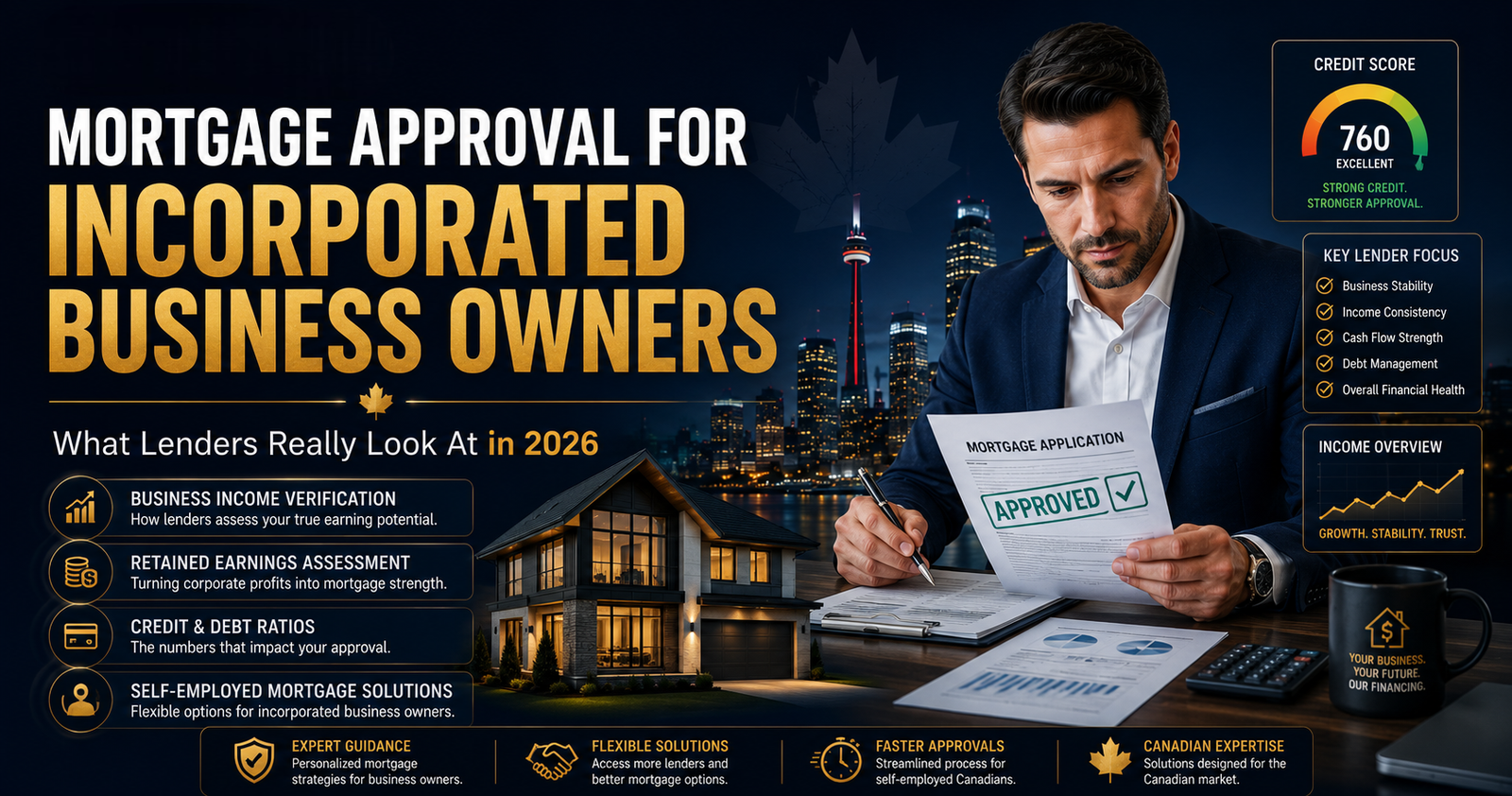
Mortgage Approval for Incorporated Business Owners: What Lenders Really Look At (2026 Guide)
For many entrepreneurs in Canada, getting approved for a mortgage can be more complicated than it is for traditional salaried employees. Even successful business owners with strong revenues often face challenges because their income structure differs from what banks typically prefer.
If you’re an incorporated business owner, understanding how lenders evaluate mortgage applications can significantly improve your chances of approval.
In this guide, we’ll explain what lenders really look at when assessing an incorporated business owner mortgage application and how self-employed Canadians can prepare for success.
Why Mortgage Approval Is Different for Incorporated Business Owners
Traditional employees typically provide:
- T4 slips
- Employment letters
- Recent pay stubs
Business owners, however, often:
- Minimize taxable income for tax efficiency
- Retain profits within their corporation
- Receive income through dividends
- Have fluctuating annual earnings
As a result, lenders must take a deeper look into the overall financial picture.
What Is an Incorporated Business Owner Mortgage?
An incorporated business owner mortgage is a mortgage designed for entrepreneurs who operate through a corporation rather than earning a regular salary from an employer.
Common examples include:
- Consultants
- Contractors
- Real estate professionals
- Agency owners
- E-commerce entrepreneurs
- Small business owners
- Medical professionals operating corporations
Many lenders now offer specialized self-employed mortgage programs to accommodate these borrowers.
What Lenders Really Look At
- Business Income Stability
One of the first things lenders assess is whether your business generates consistent income.
They want to see:
- Stable revenue trends
- Ongoing business operations
- Sustainable cash flow
- Long-term viability
Lenders generally prefer businesses with at least:
- 2 years of operating history
- Consistent or growing revenue
- Personal Income Drawn From the Corporation
Even if your corporation generates significant revenue, lenders also want to know how much income you personally receive.
This may include:
- Salary
- Dividends
- Management fees
- Shareholder distributions
Some business owners intentionally reduce personal income to lower taxes, which can affect mortgage qualification.
- Corporate Financial Statements
Many lenders review corporate financials to understand the strength of your business.
Documents may include:
- Corporate tax returns
- Financial statements
- Profit and loss statements
- Balance sheets
These documents help lenders evaluate the company’s financial health.
- Retained Earnings
Retained earnings can be an important factor for incorporated borrowers.
Retained earnings are profits left inside the corporation after expenses and taxes.
Strong retained earnings may demonstrate:
- Business stability
- Financial reserves
- Future earning potential
Some lenders will consider retained earnings when evaluating mortgage affordability.
- Personal Credit Score
Credit remains a major approval factor.
Most lenders prefer:
- Strong repayment history
- Low credit utilization
- Minimal outstanding collections
A higher credit score can help:
- Improve approval chances
- Access better mortgage rates
- Reduce lender concerns about risk
- Down Payment Amount
The size of your down payment can significantly influence approval.
Larger down payments often:
- Reduce lender risk
- Improve debt ratios
- Increase financing options
Business owners who can provide 20% or more down may access additional mortgage programs.
- Debt Service Ratios
Lenders calculate:
Gross Debt Service (GDS)
Measures housing costs compared to income.
Total Debt Service (TDS)
Measures total debt obligations compared to income.
Even self-employed borrowers must meet acceptable debt servicing guidelines.
Common Documents Required for Self-Employed Mortgage Approval
When applying for a self-employed mortgage in Canada, lenders often request:
Personal Documents
- Government-issued ID
- Credit authorization
- Personal tax returns
Business Documents
- Corporate tax returns
- Notice of Assessment
- Financial statements
- Business licenses
- Articles of Incorporation
- Business bank statements
Providing organized documentation can speed up approval considerably.
Mortgage Options for Incorporated Business Owners
Traditional Bank Mortgages
Suitable for borrowers with:
- Strong credit
- Consistent income
- Established business history
Advantages:
- Lower rates
- Longer terms
- Competitive products
Stated Income Mortgages
Many lenders offer stated-income programs specifically for self-employed borrowers.
These programs allow lenders to assess:
- Business revenue
- Industry norms
- Bank statements
- Business activity
instead of relying solely on taxable income.
Alternative (B-Lender) Mortgages
Useful when:
- Income is difficult to verify
- Credit needs improvement
- Traditional lenders decline the application
Benefits:
- More flexible qualification requirements
- Faster approvals
- Alternative income verification
Private Mortgages
Private mortgages can help borrowers who:
- Need short-term financing
- Have complex income structures
- Require fast approvals
Private lenders often focus more on:
- Property equity
- Asset position
- Exit strategy
rather than conventional income calculations.
How Incorporated Business Owners Can Improve Approval Chances
Keep Financial Records Organized
Maintain accurate:
- Bookkeeping
- Tax filings
- Financial statements
Lenders appreciate transparency.
Build Strong Credit
Pay:
- Credit cards
- Loans
- Lines of credit
on time consistently.
Reduce Existing Debt
Lower debt obligations improve debt service ratios.
Increase Your Down Payment
A larger down payment often compensates for complex income situations.
Work With a Mortgage Broker Experienced in Self-Employed Mortgages
Not all lenders evaluate self-employed borrowers the same way.
An experienced mortgage professional can:
- Match you with suitable lenders
- Structure your application properly
- Present corporate income effectively
Common Mistakes Business Owners Make
Underreporting Income Excessively
Aggressive tax planning may reduce mortgage qualification ability.
Mixing Personal and Business Finances
Separate accounts improve financial clarity.
Applying Without Updated Financial Statements
Outdated documentation can delay or derail approvals.
Ignoring Credit Issues
Small credit problems can become major lending concerns.
Final Thoughts
Obtaining an incorporated business owner mortgage in Canada requires a different approach than traditional mortgage applications.
Lenders evaluate far more than simply your personal income. They examine:
- Corporate earnings
- Business stability
- Retained profits
- Credit history
- Cash flow
- Overall financial strength
With proper preparation, organized documentation, and the right mortgage strategy, self-employed Canadians can successfully secure competitive mortgage financing.
Whether you’re purchasing your first property, upgrading your home, or refinancing, understanding what lenders really look at can put you in a much stronger position for approval.
FAQ
Yes. Many lenders offer mortgage programs specifically designed for incorporated and self-employed borrowers.
Most lenders prefer at least two years of self-employment or business operating history.
Some lenders do consider retained earnings and corporate profits when assessing mortgage affordability.
While requirements vary, stronger credit scores generally improve approval chances and access to better rates.
Yes. Many lenders accept dividend income, though documentation requirements may differ.
In negotiations, I’ll represent you. When it comes to discussing mortgages with their bank, many customers are unsure or uneasy. Even if you have an existing relationship with your branch, I can use that relationship to your advantage when negotiating your mortgage, ensuring that you get the best rates and terms possible. Call me right now for a free, no obligation consultation. Call +1 (431) 999-8485 or Apply now!